A Croatian holiday filled with coastal scenery, culture and charm
Croatia’s coastline offers more than beautiful beaches; it brings together Roman ruins, Venetian facades, pine-fringed coves, and a daily rhythm shaped by the Adriatic. For travelers who want scenery with depth, that mix makes the country especially compelling, because natural beauty and cultural memory sit close together. This article follows the coast through its landscapes, towns, cuisine, islands, and practical travel choices. Keep reading to see how a Croatian holiday becomes memorable through detail rather than display.
Outline: 1) the structure and scenery of the Adriatic coast; 2) the towns where history shapes the waterfront; 3) cuisine, customs, and everyday social life; 4) island routes and experiences on the sea; 5) practical planning advice and a concluding guide for travelers choosing the right style of Croatian holiday.
The Adriatic Stage: Why Croatia’s Coastal Scenery Feels So Distinct
Croatia’s coast is often described as dramatic, but the word earns its place here. The mainland shoreline stretches for roughly 1,800 kilometers, and when the country’s islands are included, the total coast exceeds 5,800 kilometers. That geography creates unusual variety in a relatively compact space. A traveler can leave a historic stone town in the morning, swim beneath a cliff backed by scrub and pine in the afternoon, and watch the sunset from a ferry deck while islands appear one after another like stepping stones on the horizon. Unlike some Mediterranean destinations where long sandy strands dominate the image, much of Croatia’s coast is shaped by limestone, coves, pebbled beaches, and clear water that owes part of its brightness to the rocky seabed and generally low sediment levels.
The coast is not one continuous scene, and that is part of its charm. Istria in the north has a softer profile, with green hills, fishing ports, and towns that often recall Venetian influence. Kvarner mixes elegant seaside resorts with island views and a slightly calmer, more Central European mood. Dalmatia, stretching farther south, is what many travelers picture first: rugged mountains dropping toward the sea, fortified towns, and long island chains that seem to catch the light differently each hour. Key contrasts include:
• Istria: gentler landscapes, olive groves, and polished harbor towns.
• Kvarner: refined promenades, Austro-Hungarian traces, and easy ferry access.
• Dalmatia: bolder rock formations, stronger island culture, and iconic historic centers.
What makes this scenery matter for a holiday is not only how it looks, but how it structures the day. The coast invites movement. You walk, swim, pause for coffee, board a boat, and return to a town square as evening cools the stone. Even the climate supports this rhythm. Summer is typically hot and dry, while late spring and early autumn offer warm sea temperatures with fewer crowds. Compared with parts of Spain or southern Italy, Croatia can feel slightly less expansive in urban scale, yet more intimate in how sea, settlement, and landscape sit tightly together. It is a place where the horizon keeps changing, but the sense of place remains clear.
Stone, Squares, and Seafront History: The Cultural Depth of Coastal Towns
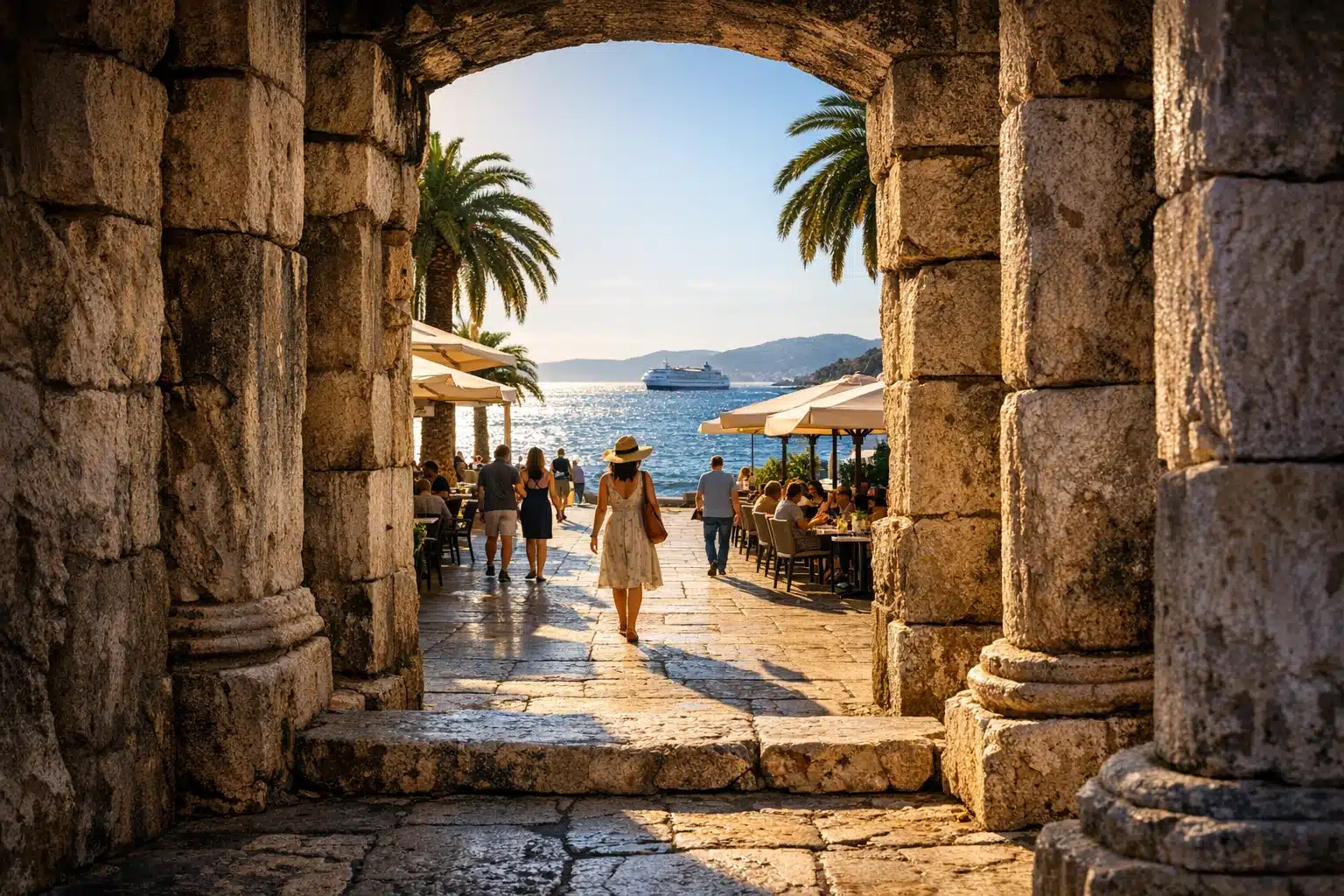
The Croatian coast rewards travelers who want more than a scenic backdrop, because many of its towns are living records of layered history. Roman, Byzantine, Venetian, Austro-Hungarian, and Slavic influences do not sit in separate museum rooms; they appear in street plans, church towers, city walls, arches, and local habits. Split is one of the clearest examples. At its center stands Diocletian’s Palace, built around the beginning of the fourth century for the Roman emperor Diocletian. What makes it remarkable is not simply its age, but its continued use. Shops, homes, cafes, and narrow passages occupy a space that once served imperial life. It feels less like a monument sealed off from the world and more like history still breathing through the pavement.
Dubrovnik offers a different experience. Its limestone streets, defensive walls, and sea-facing fortifications express the confidence of the former Republic of Ragusa, a maritime state that once traded across the Mediterranean. Walking the walls gives visitors a practical lesson in how architecture answered politics, commerce, and defense. Zadar, by contrast, is more open in mood, blending Roman remains, medieval churches, and modern waterfront installations such as the Sea Organ and Greeting to the Sun. Rovinj in Istria leans toward intimacy, with a hilltop church, pastel facades, and a harbor atmosphere that often leads travelers to compare it with parts of Venice, though it remains distinctly Croatian in language, rhythm, and setting.
Several coastal sites are also recognized by UNESCO, including Dubrovnik’s Old City, the historic center of Trogir, Split with Diocletian’s Palace, and the Cathedral of St. James in Šibenik. These designations matter not as trophies, but as evidence of international cultural value. A holiday along the coast can therefore include meaningful encounters with art, urban history, and architecture without demanding a rigid museum itinerary. One of Croatia’s strengths is accessibility. You do not need to study for weeks before arriving. A town square, a bell tower, a loggia, or a weathered portal often tells enough of the story to draw you in. Then the deeper layers begin to appear, one street at a time.
Flavor, Ritual, and Everyday Warmth: How Culture Lives Beyond the Landmarks
Culture on the Croatian coast is not limited to monuments; it also lives in the routines that shape a day. Morning markets, coffee taken slowly, conversations on promenades, and evening meals that stretch without hurry all contribute to the feeling many visitors describe as charm. That word can be vague, so it is worth defining here. In Croatia, charm often comes from scale and continuity. The fish market still matters. Olive oil is not decorative language on a menu but a staple of regional identity. Families meet in old town squares that were important long before modern tourism arrived. The result is an atmosphere that feels inhabited rather than staged.
Food varies by region, yet the coast shares several culinary threads: seafood, olive oil, wine, herbs, and produce shaped by a Mediterranean climate. Travelers will encounter grilled fish, octopus salad, black risotto colored with cuttlefish ink, mussels, and simple plates where freshness is the main argument. Inland influences also appear, especially in slower dishes and festive cooking. In Dalmatia, peka, a traditional method of cooking meat or seafood under a bell-like lid, offers a richer, more rustic contrast to lighter seafront fare. In Istria, truffles, handmade pasta, and excellent olive oils create a profile that some compare with northeastern Italy, though local varieties and Croatian winemaking give it a separate character. A table along the coast might include:
• Sardines or sea bream grilled with little more than oil and salt.
• Pašticada, a slow-cooked beef dish often served on celebratory occasions.
• Local cheeses, figs, anchovies, and bread as part of a simple shared start.
• Wines such as Malvazija in Istria or Plavac Mali farther south.
There is also music, festival culture, and a strong sense of season. Summer brings open-air events, religious feasts, folk performances, and klapa singing, a traditional Dalmatian style known for close vocal harmonies. Even when a traveler does not understand every word, the sound carries place in a very direct way. Small details leave a lasting impression: laundry above an alley, a church bell at noon, old men debating in the shade, the scent of rosemary near the sea wall. These are not grand attractions, yet they often become the real memory of the trip. They turn a holiday from a checklist into an encounter with local life.
Islands, Ferries, and Sea Days: Experiencing the Coast from the Water
No account of a Croatian coastal holiday is complete without the islands. The country is commonly said to have more than 1,000 islands, islets, and reefs, though only a fraction are inhabited. That number matters less than the experience it creates: the sea is not an edge here, but a network. Ferries and catamarans connect major points, making island-hopping one of the most appealing ways to travel. For first-time visitors, this can be surprisingly manageable. You do not need a private yacht to enjoy the archipelago. Scheduled services, day excursions, and short crossings open much of the coast to independent travelers.
Each island tends to have a distinct personality. Brač is known for its stone, villages, and the famous Zlatni Rat beach near Bol, where the shape of the spit shifts with current and wind. Hvar has long drawn attention for lavender fields, historic architecture, and a polished social scene, yet beyond the busier harbor there are quieter settlements and inland views that reveal a more balanced island identity. Korčula combines medieval urban form with vineyards and a seafaring tradition. Vis, once more isolated due to its military past, often appeals to travelers seeking a slower pace, clear coves, and a sense of remove. Mljet offers dense greenery and a national park landscape, making it especially attractive to walkers, cyclists, and kayakers.
Sea-based travel also changes how Croatia is perceived. Towns that seem self-contained from land become parts of a wider maritime map. You notice distances, prevailing winds, and the practical intelligence of harbor design. A day on the water might include swimming near a rocky inlet, arriving in a port for lunch, and returning at dusk when facades turn gold and the waterfront grows lively again. For active travelers, there are options such as sailing courses, paddleboarding, sea kayaking, snorkeling, and hiking in island interiors. For slower travelers, simply taking a ferry can feel cinematic. The deck breeze, the salt in the air, the approach to an old town from the sea: this is one of Croatia’s quiet masterpieces, and it explains why so many visitors remember the crossings as fondly as the destinations.
Planning a Croatian Holiday with Character: Best Times, Routes, and Final Thoughts for Travelers
A Croatian coastal trip works best when matched to the traveler’s pace. Peak summer, especially July and August, offers the warmest sea, long daylight hours, and the fullest calendar of events, but it also brings higher prices and heavier crowds in popular places such as Dubrovnik, Hvar, and central Split. For many visitors, May, June, and September are the sweet spots. The weather is generally pleasant, ferry networks are active, and historic centers are easier to enjoy without the pressure of peak-season density. October can also be attractive for those more interested in culture, food, and walking than extended swimming time.
Route planning matters. A one-week trip usually works best with a focused approach rather than a rushed north-to-south sweep. Travelers drawn to elegant towns, gastronomy, and a gentler atmosphere might choose Istria and Kvarner, combining Rovinj, Pula, Opatija, or an island such as Cres or Lošinj. Those seeking classic Dalmatian highlights may build a route around Split, one or two islands, and Dubrovnik, allowing time for ferries and unplanned pauses. A longer journey of ten to fourteen days gives the coast room to unfold naturally. Helpful priorities include:
• Balance cities with smaller places so the trip does not become architecturally impressive but physically tiring.
• Reserve key ferry tickets in high season, especially on popular routes.
• Wear water shoes if you prefer comfort on pebbled or rocky beaches.
• Leave unscheduled time for markets, waterfront walks, and unexpected detours.
Budget also deserves realism. Croatia is not uniformly cheap, particularly in high-demand summer locations, yet it can still offer strong value when travelers mix guesthouses, family-run apartments, local bakeries, inland restaurants away from the busiest promenades, and public transport. Most importantly, think about what kind of holiday you want. This coast is ideal for readers who crave both atmosphere and variety: couples looking for romantic settings without losing cultural substance, families who want safe seaside routines plus day-trip options, and solo travelers who enjoy independent movement through ferry-connected places. The best Croatian holiday is rarely the one that tries to see everything. It is the one that lets scenery, history, and daily life meet at a human pace. When that happens, the coast does not merely look beautiful; it feels deeply worth your time.